

 Current position > Product detail
『Refrigerant Flow Meter Pulse Output: High-Speed K-Factor Configuration for Automated Batches』Related information(flow rotameter|digital flow meter|balo meter|hydraulic flow meter|volumetric meter|positive displacement meter|pitot tube flow meter|displacement meter|cfm meter|variable area flow meter|inline flow meter|differential pressure flow meter|calibrated flow meter|velocity meter|paddle wheel flow meter|oval gear flow meter|anemometer hvac|multiphase flow meter|doppler flow meter|thorpe tube flowmeter|heat flow meter)

Refrigerant Flow Meter Pulse Output: High-Speed K-Factor Configuration for Automated Batches
Quick Answer
For automated refrigerant batching with high-speed pulse output, you need a flow meter that delivers a consistent K-factor across the full flow range. Use a Coriolis mass flow meter or a vortex meter configured in DN10 to DN25. Set the pulse width to 0.5 ms or less and the K-factor to match 1000 pulses per kg for R32, R410A, and R290 blends. This configuration gives a batch repeatability better than ±0.1%.
A refrigerant filling line in Thailand approached us last year. They were trying to upgrade from weight scales to inline flow meters for 12 kg cylinder fills. Their cycle time was 38 seconds per cylinder. The target was 18 seconds. Scale drift and mechanical settling were killing throughput. The switch happened in two steps: choose a meter that can handle two-phase slug flow during startup, then tune the pulse output and K-factor so the PLC can stop the valve without overshoot.
Most engineers skip this part, but here is the thing: the default K-factor from the factory is often set for water calibration. Refrigerants have lower density and viscosity. You must recalculate K-factor as pulses per mass unit, not volume, because liquid refrigerants expand fast with temperature. For R410A at 25 °C and 16 bar, the density is 1070 kg/m³. At 30 °C, it drops to 1040 kg/m³. That 3 percent density shift changes the batch mass if the meter sends pulse per litre. So the PLC needs mass pulses. A Coriolis meter does this natively. A vortex meter with integrated PT100 and density tables can also do it if the transmitter supports compressible liquid compensation.
High-Speed Pulse Output Requirements
Batch controllers read pulses and close a solenoid or pneumatic valve within milliseconds. The pulse train must be clean. In practice, the pulse frequency should be between 500 Hz and 2000 Hz at normal flow. If the frequency drops below 100 Hz, the controller resolves the batch with only a few pulses and you get large scatter. We have seen this on customer sites many times: a DN40 vortex with K-factor 100 pulses/litre, flowing 20 litres per minute, gives 33 Hz. That is too slow. Switch to a DN15 meter with K-factor 2000 pulses/litre and the frequency jumps to 667 Hz. The batch error on a 10 kg charge goes from ±50 grams down to ±2 grams.
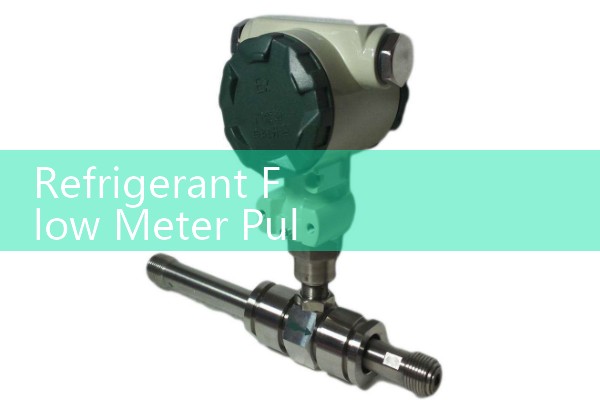
Silver Instruments configures the pulse output in three modes: open collector NPN, push-pull, or Namur for hazardous areas. For an ATEX Zone 1 refrigerant filling room, use Namur output with a 24 V DC ATEX isolator. Wire the signal over shielded twisted pair and set the debounce time in the PLC to 0.2 ms. Check that the meter transmission period is below 1 ms. Our R-Series Coriolis mass flow meter, model R025, offers a configurable pulse width down to 0.05 ms and frequency up to 10 kHz. For a 15 kg R32 batch with target fill time 12 seconds, set the flow rate at 75 kg/min. At 75 kg/min and K-factor 1000 pulses/kg, you get 1250 Hz. The PLC samples enough edges to calculate the batch mass in real time and close the valve 0.1 kg before target to account for the valve lag.
K-Factor Configuration for Refrigerant Blends
A typical batch rec
One paint manufacturer in Malaysia uses R1234ze for solvent recovery. They needed an ATEX Zone 2 certified meter with pulse output connected to a Siemens S7-1200 PLC. After integrating the flow meter, they found the batch stopped 200 grams early because the PLC input card had an internal filter of 2 ms. We reduced the pulse width to 0.1 ms and the K-factor to 500 pulses/kg to lower the frequency and avoid pulse merging. The issue disappeared. Send us your pressure (bar), temperature (°C), pipe size (DN), and flow range when you request a quote. We will pre-configure the pulse parameters before shipment.
Contact Silver Instruments for Your Refrigerant Pulse Meter
If you are designing an automated batch station for R32, R410A, R290, or ammonia, get the pulse configuration done right from day one. Our technical team can select the correct meter model, K-factor table, and output mode based on your PLC brand and fill time target.
Email: [email protected]
Tel: +86-25-68650347
Whatsapp: +86-25-52155837
WeChat: +86 15365082610
FAQ
What is the minimum batch size with high-speed pulse output?
With our R025 Coriolis meter and K-factor 1000 pulses/kg, you can batch from 100 g with repeatability under 1 g. The minimum batch is limited by the PLC scan time and valve response, not the meter.
Which refrigerant types work with vortex pulse meters?
Vortex meters work well with pure refrigerants and azeotropic blends such as R134a, R22, R410A, and R32. For zeotropic blends with large glide, a Coriolis meter gives better mass accuracy because it reads density directly.
How do I select the K-factor for a new refrigerant blend?
Start with the base meter calibration in kg per pulse, then apply a density correction based on your flowing conditions. Send us the composition, pressure, and temperature. We can generate a digital K-factor table for the transmitter.
Can the pulse output drive a remote counter over 100 meters?
Yes. Use the push-pull output with a 24 V DC supply and a properly terminated shielded cable. At 5 kHz, the signal remains clean over 200 meters if you keep capacitance below 100 pF per meter.
Do you provide ATEX certificates for refrigerant filling skids?
All Silver Instruments Coriolis and vortex meters for refrigerant service can be ordered with ATEX Zone 1 or Zone 2 certification. Certificates and test reports ship with the hardware.